Search In This Blog

Translate

Showing posts with label photography. Show all posts

Thursday, 19 May 2016

Snow Partridge

Scientific Name: Lerwa lerwa
Place: Tungnath, Chopta, Uttarakhand

Snow Partridges can be seen at higher ridges of Himalayas; through out indo-tibetan glacial areas. Mostly they forage in groups consisting of as much as 25 pax. While undisturbed they forage very silently alongside the grassy slopes of mountain. However, considering human beings as threat; they keep a minimum distance of 30 feet.

During our birding tour in Chopta and Tungnath in the month of November last week we experienced a flock of 14 foraging on grassy slopes. As we were in search of Monal, all on a sudden we saw a flock of partridge like bird flew and perched on a slope. We first thought it as a flock of Chukar. Following that flock, we moved further up, where the hill side doesn't face any sun. Silently they were foraging and making short clucking (very low pitched sounds). 

Snow Partridge (Lerwa lerwa) | 01.12.2015 | Tungnath, Chopta Valley, Uttarakhand, India
© Dibyendu Ash @ 2015


The entire flock of Snow partridge was so well camouflaged that even for a professional it is hard to find them. They were not hiding themselves rather they were into wide open in broad day light. The coloration of grassy slope and that of the feather texture of partridge mixes well. 

It was really a moment to cherish when all the participants got the photograph of this rare/hard-to-photograph beauty. In that freezing cold temperature; I experienced chilblain. Sudden snowfall on last week of December favored our luck to photograph some of the extreme high altitude avian species. Following the snowline, Snow Partridge came downhill and participants of Chopta-Tungnath birding tour from GoingWild (Nov-Dec 2015) photographed it pretty well. Other than Snow Partridge, we got Alpine Accentor, Altai Accentor, at least 20 individuals of Himalayan Monal.

Hope you have enjoyed it! To receive further updates on other birding events and sightings, be a Birding India follower (See right side bar).

Friday, 2 October 2015

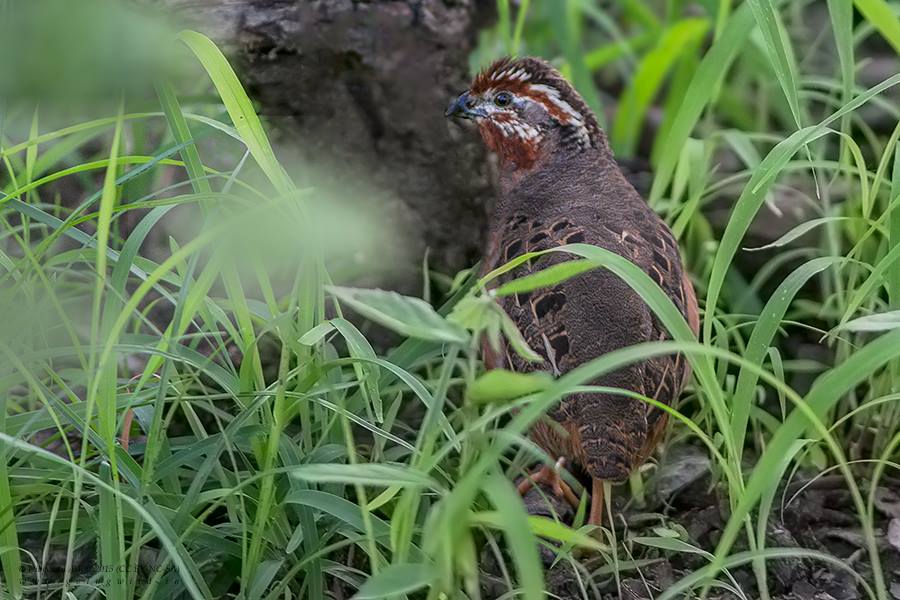
Jungle Bush Quail

Scientific Name: Perdicula asiatica
Place: Pench Tiger Reserve, Madhya Pradesh, India

Okay now, you can surely ask why am I repeatedly posting Galliformes in this blog. The answer would be - it is tough to photograph or spot them in the wild; that's why. These medium sized Galliformes are common throughout peninsular India. This bird specie is mostly active during dawn and dusk, when they come in open; otherwise a very shy avian beauty which try to avoid thereby foraging beneath bush thickets in daylight.


Jungle Bush Quail (Perdicula asiatica) | Pench Tiger Reserve, Madhya Pradesh, India
© Dibyendu Ash @ 2015 (CC BY-NC-SA)


Though they are not listed as a threatened specie as per IUCN; still rapid urbanisation and call for upliftment of concrete is a serious threat for them due to habitat loss.

During our short reconciliation tour to Pench (MP) Tiger Reserve in the month of June '15; we started from Kolkata by train and reach Nagpur by late afternoon. The journey towards the resort was fun for us, since we spotted some wildlife on our way to resort.

On 29th June '15, during our morning safari when we were returning from Touria; on our way, just beside the gypsy track some birds were getting inside the bush thickets. Curiosity drove us towards that bush, by that time the flock of 6-7 birds moved up on to a boulder and perched at eye level.

Beside the boulder, when one by one came into the opening, we got them. Everybody from the gypsy got decent photographs of the bird. Photographed one is a male of the specie.

Points to be noted:
  • Amongst galliformes, Junglefowls and Quails were domesticated since the dawn of civilization.
  • Unlike other avifauna, Junglefowls and Quails have feral and semi-feral status in India.
  • Though population is declining, but since the species covers extremely large of distribution, it is species status has been evaluated as Least Concern (See this link from Birdlife International).


Red Junglefowl

Scientific Name: Gallus gallus
Place: Sundarbans Tiger Reserve, West Bengal, India

Red Junglefowl, Probably the most common amongst all Galliformes from the family of Pheasantidae. These colorful looking avian specie are found mostly in all type of habitat in India, except arid & semi-arid landscape of western India and from south India. In south India the specie is replaced by Grey Junglefowl (Gallus sonneratii).

Previously in five days, I have posted just five different specie level article and wrote about sightings of each and every species from different wildlife sanctuaries, biosphere reserves, national parks and tiger reserves from India. Till date, in just these five days, I have been seeing the influx of birders and bird enthusiasts looking into this blog write up and they are following these articles thoroughly. I really appreciate their involvement from my heart, as they are going through each post on a regular basis. Cheers to all readers and viewers!

Now let us talk about Red Junglefowl.

On 30th December '14, during a leisure trip to Sundarbans Tiger Reserve, we were trying to mature our luck for tiger sightings. Prior to that I was there at Sundarbans five times; but the Nut didn't crack. Though common at Sundarbans, all of us were eager to see something unusual. In the mudflat everything, meant all the wildlife that we see other tiger reserves or national parks of India, looks different here at the mangroves.

Nature lovers or bird photographers those who spent their time for birding can find it beautiful against blurred background with soft-moderate light; but, here at Sundarbans what we experienced was something totally unique. A Red Junglefowl picking and dropping food items from the muddy banks of largest mangrove. After taking few snaps, I locked my eyes with my Vanguard 8 X 42mm binocular to enjoy its gait in this unusual terrain.

Here is what we saw, see the image below:


Red Junglefowl ♂ (Gallus gallus) | Sundarban, West Bengal, India
© Dibyendu Ash @ 2014


It is not only the male birds who look beautiful in this mangroves, females of this specie are beautiful too. In countless number of occasions during our birding and bird watching trips to Sundarbans we spot them at different places and islands. See the photograph of female (♀) from Sudhanyakhali watch tower of Sundarbans.

Red Junglefowl ♀ (Gallus gallus) | Sundarban, West Bengal, India
© Dibyendu Ash @ 2015

Mostly Galliformes forage on ground and their food niche is mostly ground insects and beetles. Thus it is hard to spot a Junglefowl on tree branches. Moreover, their flying gait is restricted to a certain level, it would be unusual if one can spot a Galliforme on tree branch.

I told you previously that Sundarbans is full of surprises, what you can expect elsewhere you can experience it in Sundarbans. See the below posted image which shows, Galliformes can roost on tree branches too, if it is needed as a part of their habitat niche occupancy. Tide is a major factor in Sundarbans which decides how the wildlife would live their lives here. At peak during monsoon, the differences between high tide and low tide become more pronounced. These rise and fall of water level controls habit and habitat of wild dwellers. That is due to tidal rise, these to pair of Junglefowls are perched on tree branch.

Hope you loved it! Stay tuned nature lover!

Thursday, 1 October 2015

Himalayan Monal

Scientific Name: Lophophorus impejanus
Place:


Himalayan Monal, is a bird of Galliforme family, who doesn't require a definition of beauty amongst all pheasants all over the world. A dweller of high mountain ridges of Himalayas, found chiefly between 8,500 ft to 10,000 ft during winter months and above 10,000 ft in summers and falls. Two places in this entire earth planet where these (elusive and) illusive beauty can be seen are - Chopta - Tungnath area in Uttarakhand and Pangolakha Wildlife Sanctuary (along old silk route) in East Sikkim.

Now let us start with the sighting from Chopta. Chopta valley lies in Garhwal division of Uttarakhand, covered with Alpine steppe grassland, a perfect place to roost for this high altitude galliforme. During my trip to Chopta valley for birding in the month of June '13, we started our journey from Kaladhungi. After a full day drive from foothills, we reached at an altitude of 7,700 ft at Chopta. Spending the night inside tent, next morning we started our birding days. A birding day, not to be forgotten easily, unless the head is hammered by Thor's hammer.

Morning started with sighting of Grey-crested Tit and Red-billed Chough. It was dizzling sometimes for 10-15 minutes when dark monsoon clouds were passing by, otherwise day was sunny at this altitude (at 12,000 ft).

Exactly at 10:33 AM, from the Tungnath Temple (highest Lord Shiva Temple in the world) we spotted a male perched on top a boulder to the ridge opposite to us distanced by 500 meters. After spotting his majesty, myself (Dibyendu Ash) decided to trek uphill by ~600 meters with Shanker Singh (a mountaineer guide cum paratrooper trainer). When we asked others to join us, they said a big "NO" to us, seeing the wall of mountain in front.

Myself trekking uphill towards Chandrashila, Shanker Ji was ahead of me by 50 meters.
Photo courtesy: Tamanud Mitra (Link: Original post in Facebook)
This is me going uphill towards chandrashila. No trails or paved path was there, I just had to follow Shanker ji and we two managed to trek higher and higher until we reach to a fault line. Beyond which, it would be risky. On the way once for 10-15 minutes, I lost Shanker ji and became panic stricken. Panting badly-nervous-lost I cried out loud by his name, but it was eerie and silent. At some point of time I thought probably Shanker is dead, and I am in a death circle encompassing the same path.

That 10 minutes was like hell. Now you may laugh out loud. I saw a small backpack on a boulder and Shanker ji clicking Monals sitting beneath a overhang using that as his hide. Please stop laughing now readers. Though we saw three individual females and a male; we could manage females only to be photographed, male of the specie was there only for split second. The best female of the specie I ever took was from Chopta. After procuring memory card full of images, we took rest for few minutes. I went asleep soon touched by clouds on a huge boulder, since I was too tired. After waking up from nap of nearly one hour (didn't realise how time passed by quickly); I photographed a Lammergeier and an Olive-backed Pipit.

From the top I could see the stone-cobbled path leading towards temple. In the morning, which took 50 minutes for me to trek uphill, the same path I descended down within 10 minutes and joined the group again at a local tea stall by mid noon. It was time for us to have lunch.

After a warm cup of milk-tea and a bowl full of noodles, I started reviewing images of Monal. See the image, what I was reviewing at tea stall of Chopta.


Himalayan Monal (♀ - female) | Lophophorus impejanus | Tungnath, Chopta, Uttarakhand
© Dibyendu Ash @ 2013


Later by afternoon we photographed another flock of Monals, from which I managed to photograph male (♂) of the specie too.

Himalayan Monal (♂ male) | Lophophorus impejanus | Tungnath, Chopta, Uttarakhand
© Dibyendu Ash @ 2013


Above image from Chopta-Tungnath area is not my favourite image of male bird at all. The best photograph of male bird from my conducted birding tours was from Pangolakha Wildlife Sanctuary of Sikkim during the birding tour of May 2014. Everytime, we conduct tours to Pangolakha and I mentor the tour as a knowledge expert from GoingWild; participant birders or bird photographers were never been disappointed from the sighting and photographic opportunity of Monals and other birdlife. Let me share the story of Monals from Pangolakha Wildlife Sanctuary of East Sikkim.


Two birders from Orissa joined me on a short notice for one week, where I had arranged for the entire birding trip from GoingWild. The duration of this tour was six days and their target was Himalayan Monal. 


After spending two days at Lower Pangolakha we came to 9,700 ft for 2 days of stay at Zuluk. On third day morning ...... it happened, say cheese. Both of the bird photographers were extremely happy after seeing the Monals crossing the road, Monals on Parapet, Monals roosting of grassy slopes etc.


At first we took a distant record shot, when the specimen moved uphill we drove our car to the next hairpin bending and waited for 10 minutes until we got it at eye level. See the image below, which surely qualifies it to be the most handsome looking highland dweller in Himalayas. 


Himalayan Monal (♂ male) | Lophophorus impejanus | Pangolakha Wildlife Sanctuary, East Sikkim, Sikkim
© Dibyendu Ash @ 2014


Later that evening we celebrated the sighting with Ti-momo and vegetable-rice noodles!

Though male birds are easy to spot in the wild due to their metallic glossy blue plumage, it is hard to spot females of the species where vegetation is too thick. As I said, previously, Pangolakha WLS never disappoints me; myself along with other participants always see females as isolated individuals or in a group.

During our trip to Upper Pangolakha birding trip at Zuluk - Nathang valley in the month of May 2015, again we spotted female just like the previous tour in April 2015. In the month of April, we saw more of a record image, whereas this time in May, we saw female birdie in open and managed a better photograph. See the image below, you will get some idea.


Himalayan Monal (♀ - female) | Lophophorus impejanus | Pangolakha Wildlife Sanctuary, East Sikkim, Sikkim
© Dibyendu Ash @ 2014


  • Do you know why male pheasants are more colorful than female individuals?
  • Do you have any answer? 
You can leave the answer in comment section. We can discuss the matter.

Things you should know about Monals - 
  1. They say it has nine colors, 
  2. Himalayan Monal is the National Bird of Nepal.
  3. It is the State Bird of Uttarakhand.
  4. In nepali they call it "Danphe".
  5. Kevin, a Himalayan Monal, was an animated bird character for the Hollywood movie Up (2009)
Hope you enjoyed this write up, stay tune fellow readers and birders! Have a nice day ahead!


Wednesday, 30 September 2015

Satyr Tragopan

Scientific Name: Tragopan satyra
Place: Pangolakha Wildlife Sanctuary, East Sikkim, Sikkim

“Mournful call of an elusive bird - Satyr Tragopan”


As promised in previous blog (writing of Hill Partridge), here is what I present to you readers.

Previous night (27th May 2015), I had a conversation with tour participant Manu regarding - the sighting of Satyr Tragopan, the mournful baby-cry call of it and how gorgeous looking the bird really is - over a pint of Honey-Bee.


On second day of May 2015 (i.e. 28th May) birding trip in Pangolakha WLS, when our search was on for beautiful Monals; suddenly we heard the call of satyr and searched for it alongside the slopes of zig-zag road. It was perched downhill on a parapet(on a abandoned landslide road) around 40 yards away from where tour participants stood. All the participants got some decent images of this rare beauty.


Hope you are enjoying reading this blog, but if you think you are wasting your valuable time going through for no good reason, close this tab.


In general bird nomenclature consist of after some ornithologists or the place it is/was found abundantly or the coloration of body parts; but the nomenclature of "Satyr Tragopan" has been derived from Greco-roman mythology - A drunken, lustful God who stays in deep woodland.


Tuesday, 29 September 2015

Hill Partridge

Scientific Name: Arborophila torqueola
Place: Near Ramakrishna Mission Ashram, Pangot, Uttarakhand, India

'One of the most elusive bird to see in wild!' - This is how the bird could be explained in one sentence. Mainly an altitudinal migrant like other Galliformes of Himalayas, which prefer to roost at lower altitudes ~ 5,000 to 7,000 ft in western Himalayas during winter months and ~8,000 to 10,000 ft during summer and falls.

Unlike other birds, it is not expected to be seen, but one can hear the call of Hill Partridge from miles away. At the same time I must say - 'when a birder is out for birding, he should not keep this specie in his expected bird list, unless it is God's gift.' I still remember my maiden day for sighting of the specie, in broad daylight, along with six more birding tour participants, for 2 seconds. Somehow I managed to get a record image of the birdie amongst all of them, though the windscreen of the vehicle. That is why the outcome is poor!

As usual birdlife was very rich during our October 2014 trip to Ghatgarh, Sattal and Pangot area. It was 3rd birding day, and all of us set out for Pangot in search of Cheer Pheasant. We were doing on the way birding, by taking pit stops at places, wherever flocks of birds were sighted. This is how, we were going uphill all the way from Ghatgarh(1,020 mtr) to Pangot(2,200 mtr). All on the sudden, as we were passing through a temperate broadleaf section of montane forest by car; a bird of Galliforme type appeared 50 odd feet away from us on road. It stood on road for 2 seconds and jumped into the ditch following a stream of water and vanished beneath the thickly foliaged bush. - This was the making of the this image! I hope someday some other birding group would see it too and achieve something which would definitely be a memory to cherish for them.

Hill Partridge (Arborophila torqueola) | Pangot, Nainital, Uttarakhand, India
© Dibyendu Ash @ 2014
Later that day, after reaching to Cheer Point, we searched for Cheer Pheasant but couldn't spot any of them. Like I said previously, what is expected to be seen may not be seen during birding; but the thing that is least expected can be spotted by God's grace. All the birders was overwhelmed to see this rare beauty in wild (for 2 guys it was a maiden birding trip, what a start for them!).

Since the day I was into birding or conducting birding trips, two birds that is needless to be mentioned, whose calls can be heard from kilometers away, are - Hill Partridge and Satyr Tragopan. In Sikkim Himalayas also I hear both of them, when I am out for Pangolakha Wildlife Sanctuary or Fambong Lho Wildlife Sanctuary; but one need to have persistent luck for that.

Would post a blog write up about sighting of Satyr Tragopan too in near future. Stay tuned guys!!

Monday, 28 September 2015

Grey Francolin

Scientific Name: Francolinus pondicerianus
Place: Saltpan of Tal Chappar Blackbuck Sanctuary, Churu, Rajasthan

Grey Francolins are very much common in dry, semi dry-arid landscapes of peninsular India and Pakistan. These specie was described by Rudyard Kipling as - "The creature follows its master with a rapid and pretty gait that suggests a graceful girl tripping along with a full skirt well held up. The Indian lover can pay his sweetheart no higher compliment than to say she runs like a partridge" in Kipling's book of Beast and Man in India.

During the birding trip of GoingWild at Tal Chappar Blackbuck Sanctuary in the month of February 2013, below shown photograph was taken. Like other Galliformes, they also tend to show shy characteristics; but more approachable than others. On 14th of February 2013, before spending few days at Keoladeo Ghana Wildlife Sanctuary, we spent for three full days of birding at Churu district of Rajasthan. Unlike the birds of Himalayas, birds are more cooperative here and they become active throughout the day. Thus on day one (14th February '15), as we got this beauty without spending much effort, our birding trip started smoothly.
Grey Francolin (Francolinus pondicerianus) | Tal Chappar Blackbuck Sanctuary, Churu, Rajasthan
© Dibyendu Ash @ 2013


The entire flock was consisted of 6-7 birds foraging beside the saltpan in the mid day. When we were taking photographs of Crested Lark, rapid calling started among the flock members, considering human being as threat. The sudden burst of call, drew our attention from Lark to Francolin. All the tour participants got excellent image of the specie.

Tal Chappar Blackbuck Sanctuary and adjacent area of Churu district falls under greater Thar desert area landscape. Fauna found here are endemic to this region only, through Grey Francolin is a widespread resident in India. To do birding, bird watching and bird photography in Tal Chappar, Jorbeer, Bikaneer carcass dumping ground of Rajasthan; one can get in touch with GoingWild!